If you’ve ever taken a photography class, or read books on photo techniques, you know that you’re just supposed to know the list of ‘full stops’. Everyone knows that (for instance) f 3 is not a ‘real’ f stop. Why not?
For those of us who cut our teeth on film cameras, we remember when lenses actually had an ‘aperture ring’ on the lens barrel. It was labeled with ‘real f-stops’.
Let’s all recite them in unison:
f: 1.4, 2, 2.8, 4, 5.6, 8, 11, 16, 22…
f 1 is a real stop too, but I don’t think I’ve ever seen a lens that could go that wide. (If there is such a lens, I can’t afford it anyway!)
As a reminder, larger f numbers are smaller apertures, which let in less light (and have more depth of field) than smaller f numbers. When going from a smaller number (f 4, for instance) to a larger number (f 16) you are ‘stopping down’ – that is you’re letting less light through the lens.
Going from a smaller number (larger opening) to the larger numbers (smaller opening), each stop let’s in half the light than the previous stop.
(This brings us to another topic – reciprocity, which says that (for example) f8 at 1/50 second is the same exposure as f5.6 at 1/100 second. Let twice as much light through the lens f8 to f5.6, and cut the shutter speed in half, it’s the same exposure.)
But why? (Math phobics, please keep reading!)
Because of A=πR2.
The area of a circle is pi times the square of the radius. (pi is some magic number (3.14…) that has to do with the math of circles, and the radius of a circle is half the diameter of the circle.)
What does this have to do with photography? Simple. The amount of light a lens lets through depends on the area of the circle of the aperture.
An f number is simply a fraction. f/2 is a lens opening that is ½ of the focal length of the lens. So a 100mm lens has a 50mm opening at f/2. Just like ½ is more that ¼, f/2 lets in more light than f/4.
If you start at f/1 and did the math, you’d find that f/1.4 is a circle (lens opening) with half the area as f/1. f/2 has half the area as f/1.4 and so forth through all the ‘full stops’. (Math purists will point out that this is not technically correct – they’re right. This is because the calculators used in the 1600s didn’t have as many decimal points as today’s calculators… 🙂 )
Math phobics can stop reading here – math geeks, please read on.
Here is a table that shows the mathematical progression of areas and f stops.
Assume a 100mm lens.
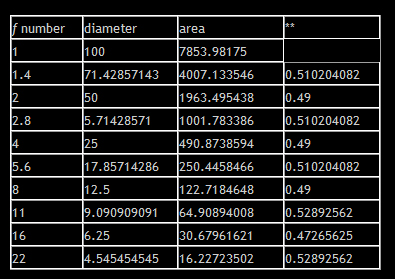
** this column shows the percentage of this calculation compared to the one before it. .500000 would be perfect.
As you can see, this is a pretty good approximation. If we tried to use the actual fraction (f/11.313 for instance) we’d have a real hard time printing it on the aperture ring. (Oh yeah, we don’t have aperture rings anymore…)